

Intelligent Glazing for ceramic sanitaryware
Genitec presents its fully automatic glazing system for the sanitaryware industry.
In the rapidly-evolving ceramic sanitaryware sector, glazing has become a key area of technological innovation. Robotic systems now set new standards of precision, efficiency and consistency in every stage of production, delivering high performance with reliable, high-speed equipment.
For years, Genitec has offered fully automatic glazing systems designed to meet all glazing requirements. Various operating configurations are available depending on the type of products to be glazed and customer preferences, each with its own advantages.
The system features a double-sided carousel with two additional axes integrated into the robot. This allows 8-axis operation and makes the system suitable for fully automatic or semi-automatic use when combined with an automatic conveyor and manipulator, significantly reducing labour requirements.
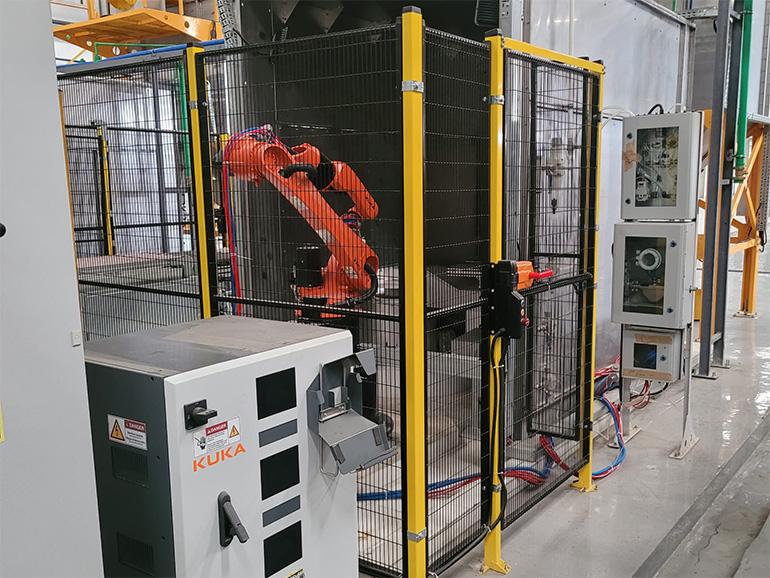
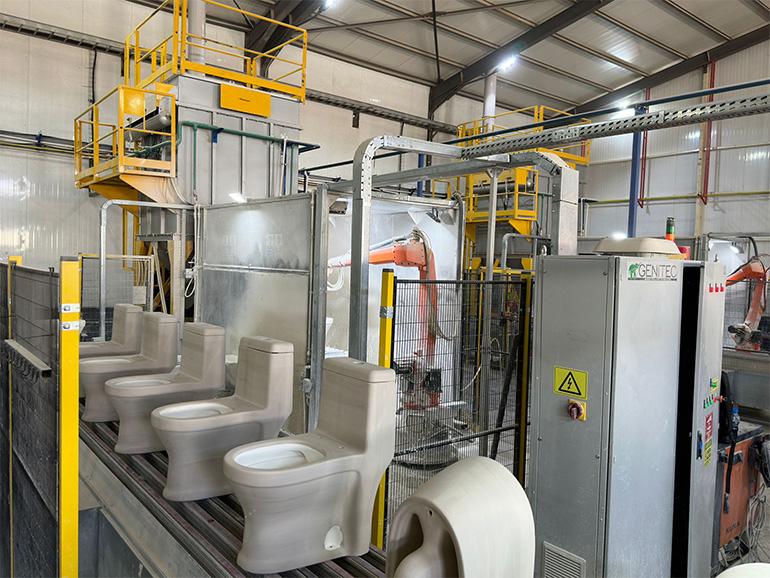
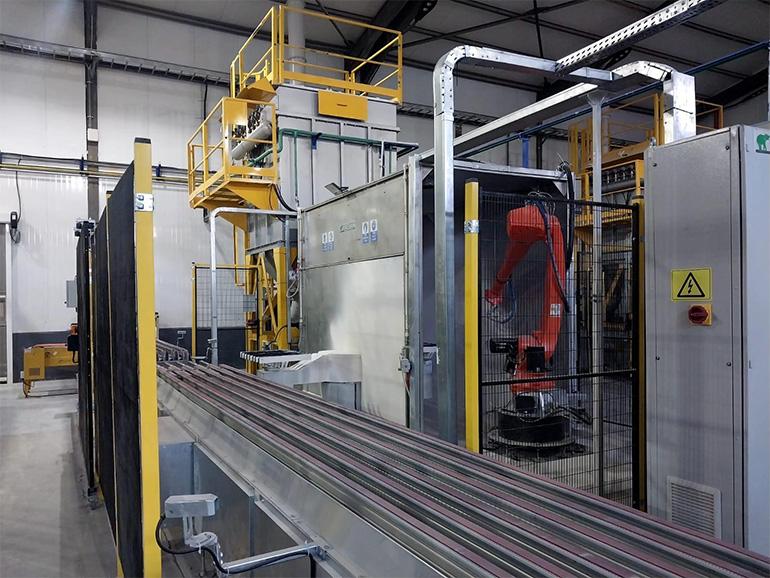
The system consists essentially of a 6+2-axis Kuka industrial robot, a stainless steel glazing booth and a dry filtration unit. The booth is equipped with a two-arm carousel loading system and a servo positioner for the carousel.
The system’s electronics include a touch-screen user interface, a latest-generation high-speed PLC and all necessary safety equipment.
The dry filtration system includes a high-power suction fan, connecting equipment and a waste glaze collector. The glazing equipment includes a mass control unit, a proportional air preparation system, a glaze pump and two spray guns with technology designed to minimise maintenance and spare parts costs. The system is also equipped with safety fencing, a waste glaze mixer and other auxiliary components. Optional features include an automatic loading conveyor, loading manipulator, unloading conveyor and touch-up booth.
One major advantage of the Genitec glazing system is its offline programming capability based on simulation software, which avoids the need to interrupt the robot’s operation. Programming can also be carried out with the robot stationary via the Kuka control panel. Once programming is complete, there is no need to modify the entire programme: the point-to-point feature allows specific points to be updated in real time, making programming simple and flexible.
The system is connected to the Internet via a remote-access interface, allowing for remote assistance when needed.
Because each axis of the Kuka robot is driven by a servo motor, the system allows complete freedom of angular movement during glazing. A medium-size robot is used for standard vitrified sanitaryware, while a long-reach model is available for large items such as kitchen sinks, shower trays or one-piece WCs.
Every sanitaryware factory has models that are particularly challenging to produce, particularly as regards glazing. The robustness and flexibility of the Kuka robot allow manufacturers to streamline the process and achieve maximum efficiency.
For glazing, the robot is equipped with a proportional air-controlled spray gun, which minimises the need for maintenance and spare parts. The system also features a long-life, speed-controlled helical rotor glaze pump, a dual-proportional pneumatic air-preparation system and a flow control system capable of instantly displaying mass, density and viscosity values.
To conclude, the adoption of advanced robotic glazing technology marks a decisive step forward in the modernisation of ceramic sanitaryware production. Combining precision, consistency and flexibility, these systems offer high levels of efficiency with sharply reduced downtime and minimal maintenance. Their intelligent design ensures stable performance even under demanding conditions, while their adaptability allows them to handle complex geometries and switch smoothly between products. This results in faster production cycles and greater product variety without compromising quality or reliability. Robotic glazing therefore represents a new production paradigm that combines technological innovation, sustainability and long-term operational consistency.

Did you find this article useful?
Join the CWW community to receive the most important news from the global ceramic industry every two weeks










Read more