


U.S. Residential construction decline is slowing
Andrew Whitmire, Tile Council of North America (USA) - [email protected]
In 2025 total U.S. housing starts were 1.34 million, down 1.7% on 2024, while the remodeling sector experienced growth.
Throughout 2025, ongoing affordability constraints in the housing market, elevated interest rates, and uneven construction activity continued to weigh on ceramic tile demand in the United States, though improving macroeconomic indicators and a strengthening remodeling sector provided some relief.
Without a doubt, the residential market remained a significant constraint for the tile industry.
Mortgage rates stayed elevated, with the 30-year fixed rate averaging 6.60%. Although this was modestly lower than the rate of 6.72% in 2024, it was high by historical standards, continuing to suppress housing affordability and turnover (Source: Freddie Mac).
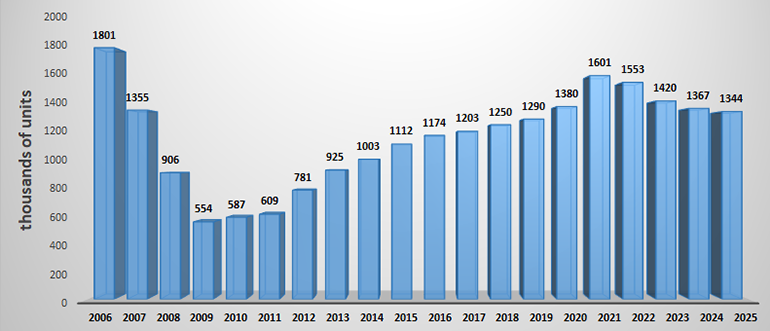
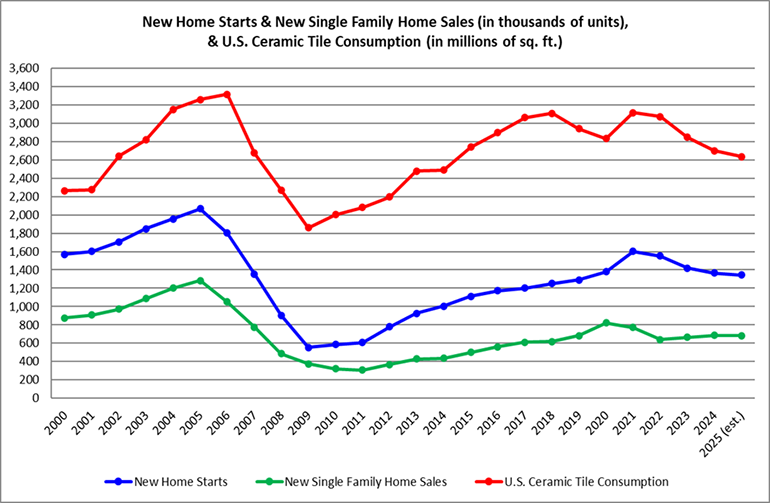
New residential construction confirmed the negative trend that began in 2021, although with a milder decline than in previous years. Total U.S. housing starts were estimated by the National Association of Homebuilders (NAHB) at 1.34 million units, a 1.7% decrease compared to 2024 and the lowest level since 2019. NAHB estimated single-family housing starts were at 941,000 units in 2025, a 7.1% decline from 2024. In contrast, multifamily starts showed solid gains from the previous year, rising 14% to 404,000 units. Single-family housing starts comprised 70.0% of total home starts in 2025, down from 74.1% the prior year.
Source: U.S. Census Bureau
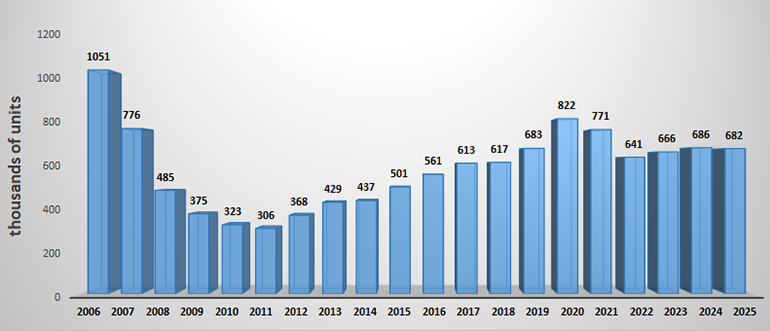
According to U.S. Census Bureau and NAHB, new single-family home sales in 2025 were at an estimated 682,000 units, a 0.6% year-over-year decline. Despite the median new home sales price falling to a four-year low ($392,300 as of October 2025) - partly due to homebuilders cutting prices and offering incentives to prospective buyers - affordability remains a major hindrance to growth.
Source: U.S. Census Bureau
Existing home sales showed modest improvement in 2025, reaching an annualized rate of 3.69 million units, up 0.5% from the prior year. Despite this increase, the 2025 total was the fourth lowest this century, with transaction volumes remaining historically subdued. According to National Association of Realtors, a key factor limiting sales was that many existing homeowners were locked into low mortgage rates, reducing their incentive to move. In addition, the median price of existing single-family homes rose again in 2025, reaching a record high of $419,500 (+1.7% compared to the previous year).
As mentioned, the remodeling sector showed positive momentum and experienced growth in 2025. NAHB’s Remodeling Market Index rose to a four-quarter high in 4Q 2025, and Harvard’s Leading Indicator of Remodeling Activity estimated 2.7% annual growth as of 4Q 2025.
From a broader economic perspective, real GDP growth strengthened in the second half of 2025, increasing at an annual rate of 4.4% in the third quarter (source: U.S. Bureau of Economic Analysis).
Total U.S. construction spending (including private and public residential and non-residential construction), which had increased for thirteen year in a row up to 2024, appears headed for a modest decline in 2025 (U.S. Census Bureau estimates -1.4% vs. 2024 based on annualized data), reflecting slower residential activity.

Did you find this article useful?
Join the CWW community to receive the most important news from the global ceramic industry every two weeks






Recent articles


Ceramic World Review 167/2026

Powtech Technopharm 2026



Main topics

Read more